
Objective of 1D-stackup analysis
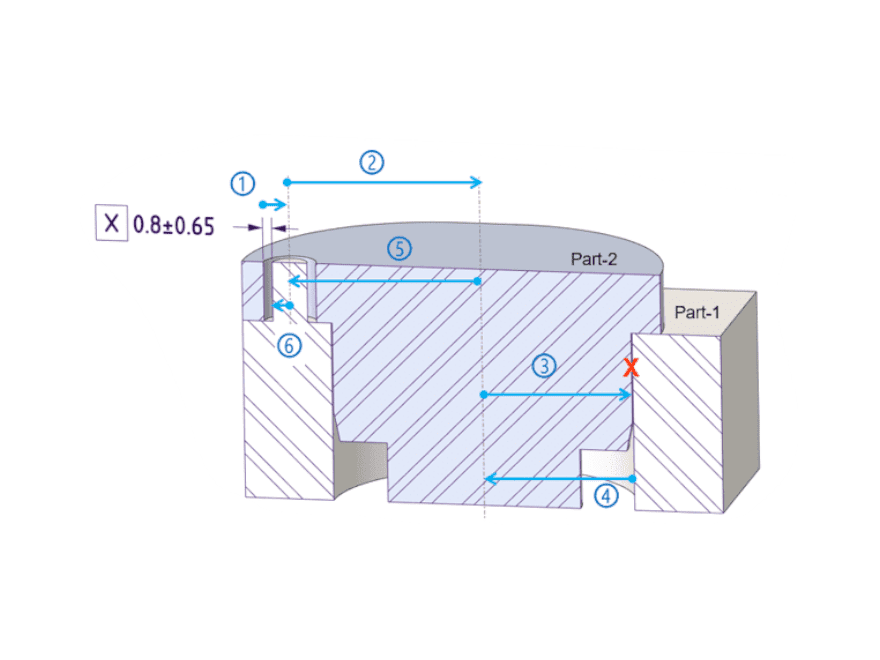
In many assemblies, tolerances are specified for each component without considering the overall effect. However, the functional dimension is created from a chain of linear dimensions. Without analysis, it is unclear which tolerances are critical and where there is a risk of accumulation.
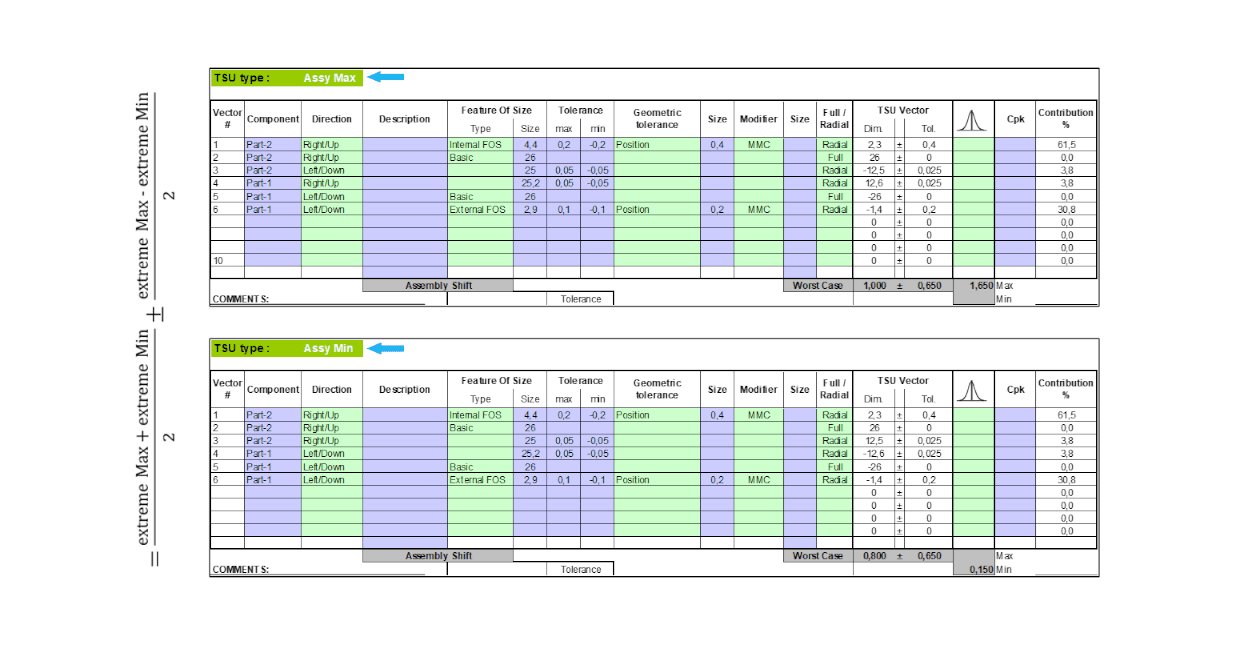
In the tolerance stackup training course, you will work with a 1D stackup analysis as a first, structured approach. You will define the functional dimension, identify the dimensional chain, and model the tolerance contributions per component.
Based on a 1D vector diagram, you determine where tolerances are too loose or too strict, where interchangeability is compromised, and where form and position tolerances are more appropriate than dimensional tolerances alone.
Do you have any questions?
Would you like to make an appointment for training, but still have questions? Check out our frequently asked questions here.
Certainly, the ISO standards have expanded considerably in recent years, especially with regard to measurement. Each customer has its own specific applications.
The best way to understand GD&T is to link theory to practice. This will give participants a better feel for the subject.
The standard two-day training is intensive, with customer drawings as a common thread. To work more specifically, a follow-up day is recommended. This gives participants time to look for examples and let everything sink in.
Contact us
If you have any questions, want to arrange training for yourself or your team or want more information about the BV Design’s services, just get in touch!
Would you like more information about the other courses?
Course Geometrical Dimensioning and Tolerancing (GD&T)
Course Model-Based Definition
Course Tolerance study
Course Drawing interpretation